

In ZENITH, a study of adults with PAH (WHO FC III or IV) at high risk of mortality on background therapy:

MORE time—WINREVAIRTM (sotatercept-csrk) significantly reduced the risk of major morbidity and mortality outcomes vs placebo

Time to first event of all-cause death, lung transplantation, or PAH
worsening–related hospitalization of ≥24 hours

This Kaplan-Meier Plot shows the time to first event of all-cause death, lung transplantation, or PAH worsening-related hospitalization of >= 24 hours in the WINREVAIR and placebo groups in ZENITH. Time is on the X-axis with markers from 0 to 120 weeks in 10-week intervals. On the Y-axis, the proportion of patients without an event is seen, from 0 to 100. The number of patients at risk at baseline and at each 10-week interval is shown below the plot. The line for the WINREVAIR group is solid magenta, and the line for the placebo group is a grey dashed line.

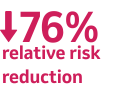
(HR= 0.24; 95% CI: 0.13, 0.43; P<0.0001)a Fifteen of 86 (17.4%) patients on WINREVAIR experienced at least 1
primary event compared with 47 of 86 (54.7%) patients on placebo.

  • Improvement was observed early in treatment with increasing benefit throughout the study. 
  • Due to overwhelming efficacy based on the primary endpoint result, the ZENITH trial was stopped early at the interim analysis. 
Components of the primary endpointWINREVAIR
(n=86)
n (%)
Placebo
(n=86)
n (%)
Number (%) of participants with ≥1 primary event15 (17.4)47 (54.7)
Components of the primary endpointb
All-cause death7 (8.1)13 (15.1)
Lung transplantation1 (1.2)6 (7.0)
PAH worsening–related hospitalization (≥24 hours) 8 (9.3)43 (50.0)

ZENITH data add to the growing body of evidence supporting a positive benefit–risk profile of WINREVAIR in a broad range of adult patients with PAH

Indication

WINREVAIR is an activin signaling inhibitor indicated for the treatment of adults with pulmonary arterial hypertension (PAH, Group 1 pulmonary hypertension) to improve exercise capacity and World Health Organization (WHO) functional class (FC), and reduce the risk of clinical worsening events including hospitalization for PAH, lung transplantation and death.

Selected Safety Information

Erythrocytosis: WINREVAIR may increase hemoglobin (Hgb). Severe erythrocytosis may increase the risk of thromboembolic events or hyperviscosity syndrome. Monitor Hgb before each dose for the first 5 doses, or longer if values are unstable, and periodically thereafter, to determine if dose adjustments are required.


Severe Thrombocytopenia: WINREVAIR may decrease platelet count. Severe thrombocytopenia may increase the risk of bleeding. Thrombocytopenia occurred more frequently in patients also receiving prostacyclin infusion. Do not initiate treatment if platelet count is <50,000/mm3. Monitor platelets before each dose for the first 5 doses, or longer if values are unstable, and periodically thereafter to determine whether dose adjustments are required.


Serious Bleeding: In clinical studies, serious bleeding (e.g., gastrointestinal, intracranial hemorrhage) was reported in 4% vs 1% (STELLAR) and 7% vs 5% (ZENITH) of patients taking WINREVAIR vs placebo, respectively. Patients with serious bleeding were more likely to be on prostacyclin background therapy and/or antithrombotic agents, or have low platelet counts. Advise patients about signs and symptoms of blood loss. Do not administer WINREVAIR if the patient is experiencing serious bleeding.


Embryo-Fetal Toxicity: WINREVAIR may cause fetal harm when administered to a pregnant woman. Advise pregnant women of the potential risk to a fetus. Advise females of reproductive potential to use an effective method of contraception during treatment with WINREVAIR and for at least 4 months after the final dose. Pregnancy testing is recommended for females of reproductive potential before starting WINREVAIR treatment.


Impaired Fertility: Based on findings in animals, WINREVAIR may impair female and male fertility. Advise patients on the potential effects on fertility.


Adverse Reactions: The most common adverse reactions (≥10% for WINREVAIR and at least 5% more than placebo) occurring in the STELLAR phase 3 clinical trial were headache (24.5% vs 17.5%), epistaxis (22.1% vs 1.9%), rash (20.2% vs 8.1%), telangiectasia (16.6% vs 4.4%), diarrhea (15.3% vs 10.0%), dizziness (14.7% vs 6.3%), and erythema (13.5% vs 3.1%). The most common adverse reactions in the ZENITH trial were infections (67.4% vs 44.2%), epistaxis (45.3% vs 9.3%), diarrhea (25.6% vs 17.4%), telangiectasia (25.6% vs 3.5%), increased hemoglobin (15.1% vs 1.2%), rash (10.5% vs 4.7%), erythema (10.5% vs 3.5%), and gingival bleeding (10.5% vs 2.3%).


Lactation: Because of the potential for serious adverse reactions in the breastfed child, advise patients that breastfeeding is not recommended during treatment with WINREVAIR, and for 4 months after the final dose.


Before prescribing WINREVAIR, please read the accompanying Prescribing Information. The Patient Information and Instructions for Use (1-vial kit, 2-vial kit) also are available.

Indication
Selected Safety Information

WINREVAIR is an activin signaling inhibitor indicated for the treatment of adults with pulmonary arterial hypertension (PAH, Group 1 pulmonary hypertension) to improve exercise capacity and World Health Organization (WHO) functional class (FC), and reduce the risk of clinical worsening events including hospitalization for PAH, lung transplantation and death.

Selected Safety Information

Erythrocytosis: WINREVAIR may increase hemoglobin (Hgb). Severe erythrocytosis may increase the risk of thromboembolic events or hyperviscosity syndrome. Monitor Hgb before each dose for the first 5 doses, or longer if values are unstable, and periodically thereafter, to determine if dose adjustments are required.


Severe Thrombocytopenia: WINREVAIR may decrease platelet count. Severe thrombocytopenia may increase the risk of bleeding. Thrombocytopenia occurred more frequently in patients also receiving prostacyclin infusion. Do not initiate treatment if platelet count is <50,000/mm3. Monitor platelets before each dose for the first 5 doses, or longer if values are unstable, and periodically thereafter to determine whether dose adjustments are required.


Serious Bleeding: In clinical studies, serious bleeding (e.g., gastrointestinal, intracranial hemorrhage) was reported in 4% vs 1% (STELLAR) and 7% vs 5% (ZENITH) of patients taking WINREVAIR vs placebo, respectively. Patients with serious bleeding were more likely to be on prostacyclin background therapy and/or antithrombotic agents, or have low platelet counts. Advise patients about signs and symptoms of blood loss. Do not administer WINREVAIR if the patient is experiencing serious bleeding.


Embryo-Fetal Toxicity: WINREVAIR may cause fetal harm when administered to a pregnant woman. Advise pregnant women of the potential risk to a fetus. Advise females of reproductive potential to use an effective method of contraception during treatment with WINREVAIR and for at least 4 months after the final dose. Pregnancy testing is recommended for females of reproductive potential before starting WINREVAIR treatment.


Impaired Fertility: Based on findings in animals, WINREVAIR may impair female and male fertility. Advise patients on the potential effects on fertility.


Adverse Reactions: The most common adverse reactions (≥10% for WINREVAIR and at least 5% more than placebo) occurring in the STELLAR phase 3 clinical trial were headache (24.5% vs 17.5%), epistaxis (22.1% vs 1.9%), rash (20.2% vs 8.1%), telangiectasia (16.6% vs 4.4%), diarrhea (15.3% vs 10.0%), dizziness (14.7% vs 6.3%), and erythema (13.5% vs 3.1%). The most common adverse reactions in the ZENITH trial were infections (67.4% vs 44.2%), epistaxis (45.3% vs 9.3%), diarrhea (25.6% vs 17.4%), telangiectasia (25.6% vs 3.5%), increased hemoglobin (15.1% vs 1.2%), rash (10.5% vs 4.7%), erythema (10.5% vs 3.5%), and gingival bleeding (10.5% vs 2.3%).


Lactation: Because of the potential for serious adverse reactions in the breastfed child, advise patients that breastfeeding is not recommended during treatment with WINREVAIR, and for 4 months after the final dose.


Before prescribing WINREVAIR, please read the accompanying Prescribing Information. The Patient Information and Instructions for Use (1-vial kit, 2-vial kit) also are available.